



The Invisible Safety Net: Why Owner Representation is the Secret to Profitable Commercial Construction
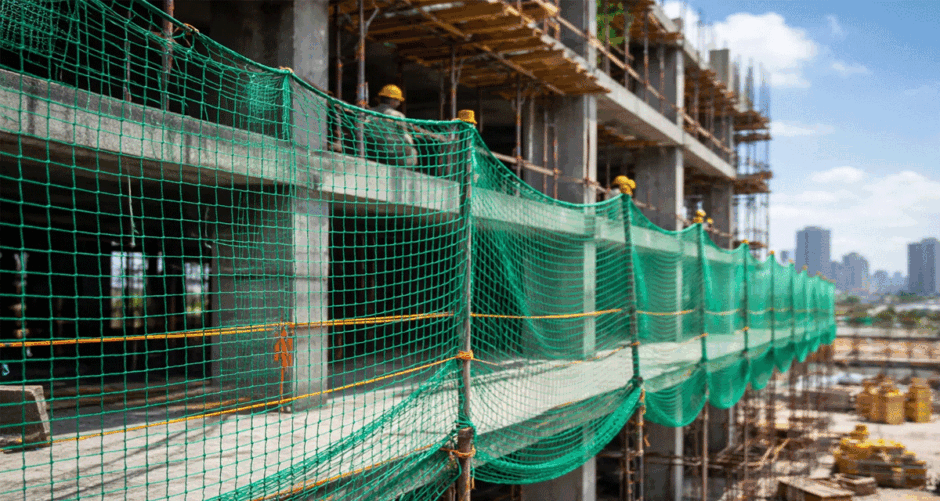
For any business leader or real estate investor, a large-scale capital project represents both a pinnacle of growth and a significant source of risk. In the fast-paced markets of Texas, particularly within the Austin and Dallas-Fort Worth corridors, the complexity of commercial construction has reached an all-time high. Between evolving energy codes, labor shortages, and intricate building technologies, the margin for error is razor-thin.
While most owners focus on hiring the right architects and general contractors, there is often a critical gap in the project hierarchy: a dedicated advocate who views every decision through the lens of the owner’s long-term business interests. This is the role of the owner’s representative, and in 2026, they are the “invisible safety net” that separates a profitable investment from a budgetary disaster.
Moving Beyond “On Time and On Budget”
Traditionally, the success of a construction project was measured by two metrics: was it delivered on time, and did it stay on budget? While these remain essential, they are no longer sufficient for a sophisticated business asset. A project can be “on budget” during the build phase but fail miserably during the operational phase if the systems were poorly integrated or the staff wasn’t properly trained.
An owner’s representative provides a level of disciplined project management that extends far beyond the construction fence. They serve as a strategic liaison, ensuring that the short-term pressures of the build—which often lead contractors to “value engineer” critical components out of the project—do not compromise the long-term ROI of the building.
Protecting the Investment: The Power of Objective Oversight
In a standard construction contract, the general contractor manages the means and methods of the work, and the architect manages the design intent. While both are essential, neither is purely incentivized to protect the owner’s financial bottom line or the building’s future operational costs.
Owner representation introduces independent, objective oversight into this dynamic. By reviewing submittals, RFIs, and change requests through an owner-centric lens, a representative can catch “scope creep” before it manifests as a six-figure change order. This proactive approach is particularly vital in the North and Central Texas markets, where rapid development timelines often lead to incomplete documentation and misaligned assumptions between trades.
Bridging the “Handover Gap”
One of the most common—and expensive—failures in commercial real estate is the “handover gap.” This occurs when a project reaches substantial completion, the contractors leave the site, and the owner’s facility team inherits a complex, high-tech building without the necessary documentation or training to run it efficiently.
A successful business asset must be operational from Day 1. Disciplined project management ensures that the transition from construction to operations is a core focus of the project lifecycle, not a last-minute afterthought. This includes overseeing comprehensive commissioning, ensuring as-built documentation is accurate and usable, and facilitating the early engagement of the facility management team. When a building “starts right,” it avoids the prolonged and costly troubleshooting cycles that often plague new developments in their first year of occupancy.
Why Local Expertise Matters in Texas
Texas construction presents a unique set of variables. From the specific demands of the ERCOT power grid to the nuances of municipal permitting in Austin and Dallas, successful outcomes require more than just general management—they require regional intelligence.
Business leaders must recognize that a building is not just a shell of steel and glass; it is a sophisticated financial and operational platform. Protecting that platform requires a partner who understands the business realities of large-scale capital projects and who is committed to transparency and accountability at every stage of the process.
At its core, owner representation is about clarity. It is about ensuring that the owner’s vision is not lost in the noise of a complex construction site and that the final delivery is a high-performing asset that contributes to the company’s long-term success.
Conclusion
In the competitive landscape of 2026, “winging it” on a multi-million dollar construction project is no longer a viable business strategy. By investing in professional owner representation, business leaders can mitigate risk, reduce stress, and ensure that their capital projects are delivered with fewer surprises and greater long-term value. In the world of commercial construction, the best-kept secret to a profitable build isn’t a cheaper contractor—it’s a better advocate.